
What do you call a cow with no legs?
Ground beef!
What do you call a Taekwondoin with bad stances?
A shame!
Let’s look at some common Taekwondo stances to avoid confusion and improve our technique!

Attention Stance 차렷 Charyeot
Setup: Feet together, toes touching, and heels touching.
Weight distribution: Even
Application: Charyeot stance is used to begin training. We always start in charyeot stance to show we are ready to give our full attention to the task at hand.
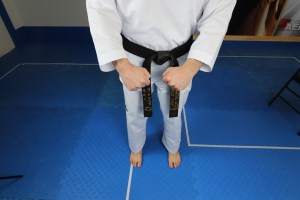
Ready Stance 준비 Chunbi
Setup: Feet parallel, one foot length apart.
Weight distribution: Even
Application: Chunbi stance is used to show we are ready to begin the training, our hands are at the center of our body and able to block or strike quickly. Feet one foot length apart means balance is good, so we are able to move or kick easily.
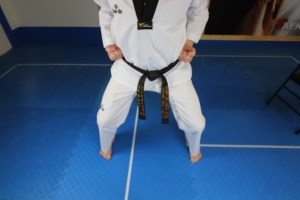
Horse Riding Stance 주춤서기 ju chum seo gi (sitting stance)
Setup: Feet parallel, two feet length apart, knees above the feet, butt sticking our slightly, back straight with good posture.
Weight distribution: Even
Application: Horse Stance is a very stable stance. Demonstrating striking and blocking motions from this position can share the true scope of your power! Holding this stance for long will build up strong hip flexors, quads, and calf muscles.
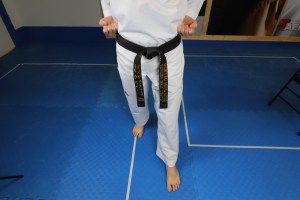
Walking Stance 앞서기 Ap Seogi
Setup: Feet are on one foot length apart (wide) and one foot length apart (long). Knees slightly bent, front foot pointing straight ahead, back foot can splay out 30 degrees to release tension in the knees and hips.
Weight distribution: Even
Application: While stepping forward to chase an opponent, or stepping backwards in a defensive way. The walking stance will mean you will not overcommit in any direction.

Front Stance 앞굽이 Ap Kubi
Setup: Feet are one foot length apart (wide), while two and a half feet length apart (long). The front knee is bent so the knee rests over the front foot. The back leg is straight, with the back foot splayed slightly at a 30 degree angle to release tension in the knees and hips. Keep the hips pointing straight ahead to keep the stance strong.
Weight distribution: Even
Application: Another very strong stance, used for reaching in while striking. If stepping in with a block and front stance, usually a quick strike will follow because you are closer to the opponent.

Back Stance 뒷굽이 Dwi Kubi
Setup: Feet are in an ‘L’ shape. The front foot points straight ahead, and the back foot points to one side (whichever side the hips are facing). The feet are two and a half feet length apart, and both knees are bent. The front foot rests under the front knee, and the back foot rests under the hip.
Weight distribution: (back) 70/30 (front)
Application: A strong defensive stance. Useful for striking with the front leg as it has less weight on it. Also strong for self defence when an attack is trying to pull you away, you are more easily able to resist.
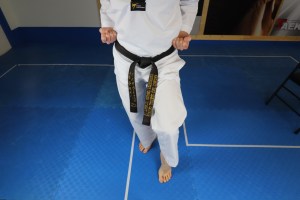
Tiger Stance 범서기 beom seo gi
Setup: From charyeo stance, move one foot forward to the heel of the front foot matches the toes of the rear foot. Go up on the ball of the front foot, making sure from the toes to the knee is one straight surface. (Imagine high heels!) Turn the back foot 30 degrees and bend your knees slightly.
Weight distribution: (back) 90/10 (front)
Application: Tiger stance is meant for kicking with your front leg. Since most of our weight is on our back leg, it is quick and easy to raise and strike with our front leg.
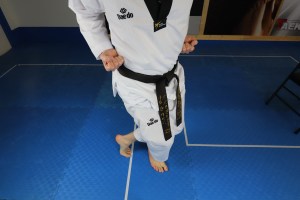
Crossed Stance 꼬아서기 Kkoa Seogi
Setup: One leg points 30 degrees from straight ahead, while the other leg crosses behind. Make sure to have the shin of the back leg touching the calf of the front; this will improve balance and the stability of the stance.
Weight distribution: Even
Application: Used in Taekwondo Poomsae (specifically Taegeuk 5 Jang and Taegeuk 8 Jang). The crossed stance is used while lunging forward. This allows the practitioner the ability to step back into a stable front stance with the back leg which is crossed behind, should the need arise.

At East Stance 편히서기 Pyeonhi seogi
Setup: Imagine a chunk stance, except you can point your toes out about 30 degrees each.. like a duck!🦆
Weight distribution: Even
Application: When the Instructor has not given formal instructions yet, practitioners may stand in ‘at east stance’ with their arms behind their back.
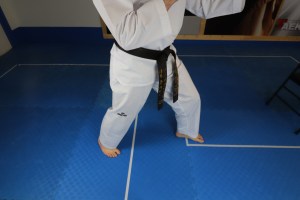
Sparring Stance 겨루다준비 Kyorugi Chunbi
Setup: With both feet pointing forward, your back foot my splay out 30 degrees. Make sure to remain on the balls of your feet for quick movement ability.
Weight distribution: Even
Application: With sparring stance we can easily slide, switch, avoid, counter, kick, and more! Make sure to bounce on the balls of your feet to remain loose and hide your moment of attack.
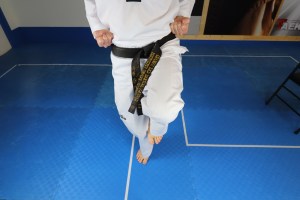
Crane Stance 학다리서기 Hak dari seogi
Setup: Raise on leg up to the level of the knee, and have the other leg bent slightly. Make sure both knees point straight ahead, and the upper leg is not resting on the lower leg’s knee joint.
Weight distribution: One leg
Application: Found in Keumgang 금강 (Second Degree Poomsae). Crane stance is one of the last remaining vestiges of the kung fu roots of Taekwondo and Karate. By balancing on one leg, the leg held in the air is placed on the inside of the knee and assists with balance. From this stance the front kick or side kick can occur quickly, and the bent supporting leg can be used as a spring to apply power from the ground into the kick.
(Also this stance is seen in the Karate kid movie!)
Anyways..
Make sure to practice the stances so we aren’t bouncing, or adjusting after our feet have been planted. Stances should be second nature!
That’s my stance on the matter…🤪
Train hard, and see you on the mats.👊
Discover more from Taekwondoshawn
Subscribe to get the latest posts sent to your email.
 Taekwondoshawn